“On the beautiful green slope of its own spacious grounds in the southern portion of [Franklin], they will behold the splendid buildings of a university superb in its proportions, whose doors stand invitingly open that all that is brightest and best of American manhood and womanhood may enter in.”
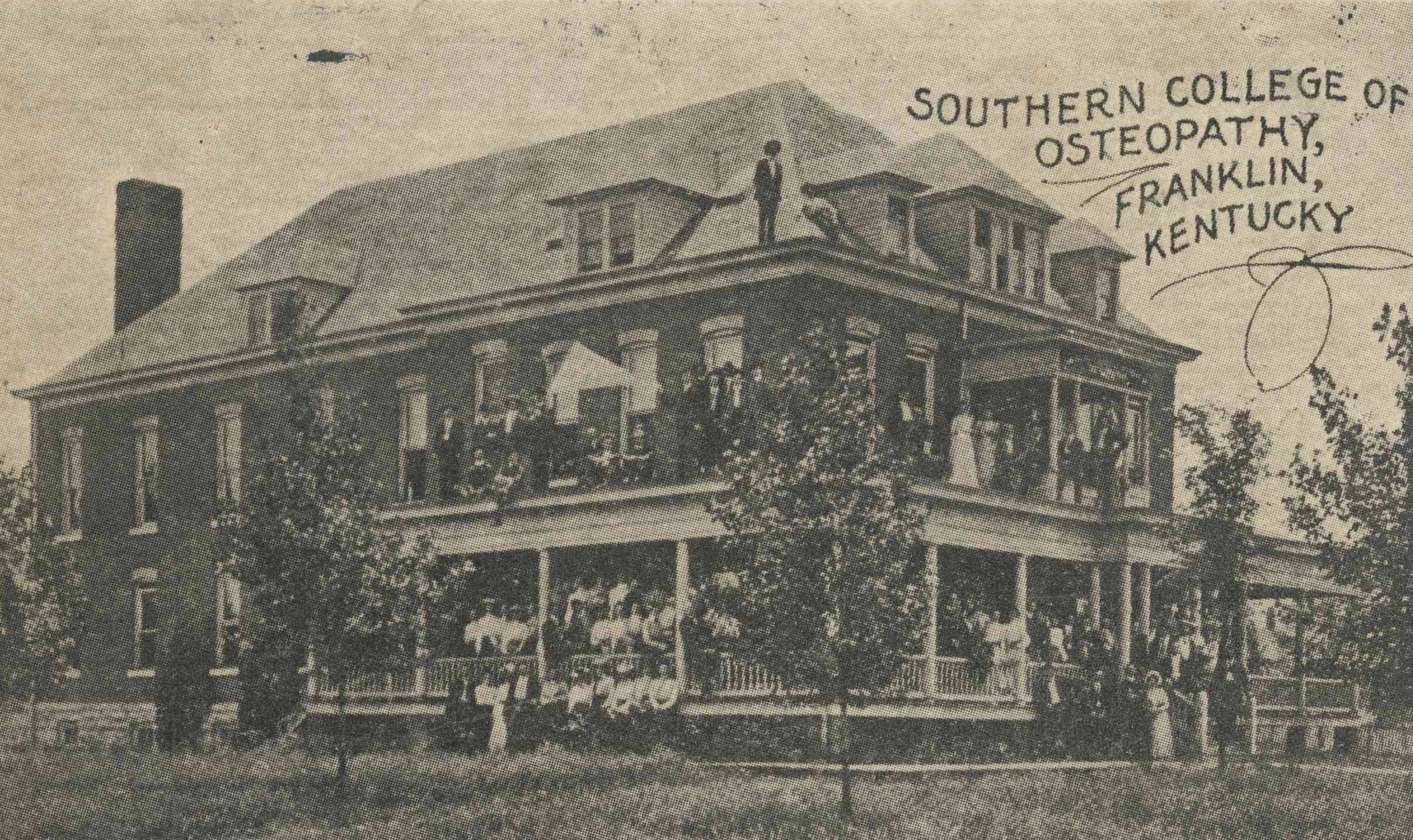
The Southern School of Osteopathy was first established in March of 1898 by George F. Nason, John S. Oldham, and J. S. Gaylord. The first president of the school was Dr. J. S. Gaylord, succeeded by Dr. J. S. Oldham and Dr. Robert W. Bowling. The first matriculated class at the school began upon its opening with a total of twenty-six students and twenty-one of them graduated. It was among the first schools of Osteopathy in the United States and quickly earned a positive, but short-lived, reputation.
The original building was “beautifully finished” in natural wood with the inside being finished in oak and yellow pine. It contained a complete system of sanitary plumbing that provided both hot and cold water, electric lights, and steam-heat in every room. There were a total for four floors in the building that were, “fitted up with everything needful in the theory and practice of the science.” The rather large basement contained the building’s furnace and coal rooms, a dedicated mail room, various bathrooms, closets, and “large and thoroughly equipped,” chemical laboratories and lecture halls. The first floor housed private and general offices along with well-furnished reception rooms for men and women, patients and pupils. On either side of the “long hall,” were treatment rooms used by students in treating patients under the supervision of the, “painstaking staff of instructors.” The second floor housed recitation and lecture rooms along with the main assembly hall with a seating capacity of about five hundred. Nearly the entirety of the third floor was used for dissection and storage purposes.
In 1901 the cost of boarding of the twenty-month program came to $10; books were around $40; tuition was $300; and a “small sum for incidentals,” put the cost of the program at around $600.
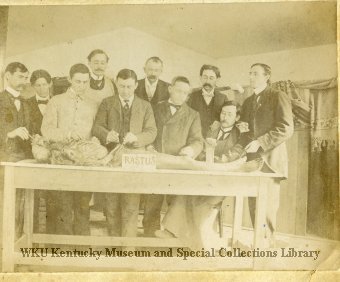
What is Osteopathy?
Osteopathy was founded in 1874 by American physician Andrew Taylor Still. Disillusioned with the ineffective medical practices of his time, Still sought a new approach to medicine. He believed that the body was a self-healing machine and that structural integrity was key to health. His new system, osteopathy, focused on the interconnectedness of all body systems, with a particular emphasis on the musculoskeletal system. He postulated that by manually adjusting the body’s structure, he could restore the proper flow of fluids and nerves, thereby allowing the body to heal itself. This revolutionary concept met with initial resistance but gained popularity over time. Still’s philosophy laid the groundwork for a distinct medical profession that today includes a wide range of diagnostic and therapeutic techniques.
Historical Osteopathic Foundations
Still’s philosophy was based on several core tenets: the body is a unified whole (body, mind, and spirit); it has the ability to self-regulate and heal itself; structure and function are interrelated; and the musculoskeletal system is central to a person’s overall health. He believed that correcting structural issues, especially in the spine, could improve blood and nerve flow and allow the body to heal from various diseases.
Historical Medical Foundations
In the 19th century, medicine was evolving but was often based on the biomedical model, which focuses on identifying and treating specific diseases or symptoms. Practices were often aggressive and invasive, including surgery, amputation, and the use of drugs that are now considered harmful. The emphasis was on fighting the disease, often without considering the body as a whole.
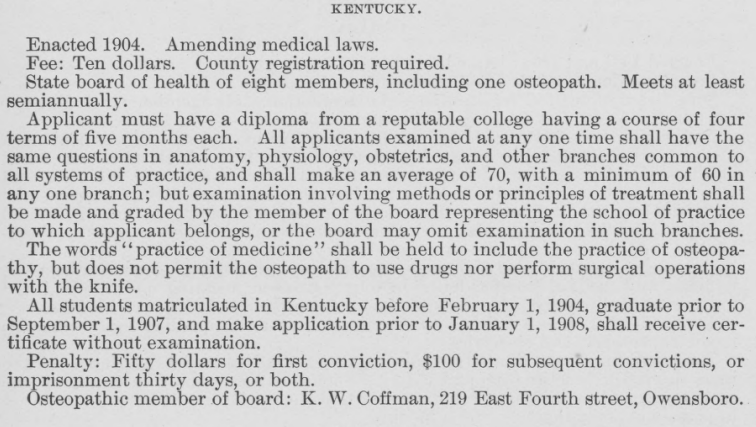
Osteopathy in general was not always well-received in the United States. In Kentucky, the Court of Appeals granted a “perpetual injunction” against the State Board of Health preventing them from further interference with the practice of Osteopathy in the Commonwealth. As a burgeoning field it differed from both allopathy and homeopathy yet struggled to differentiate itself as a legitimate field of science and medicine. The program in Franklin lasted 20 months and afforded its graduates to practice osteopathic medicine. Some reports noted that graduates from Franklin were making as much as $500 per month in 1900.
The Southern Infirmary of Osteopathy
Little is known about the specifics of the Infirmary outside of being a part of the School of Osteopathy. The Infirmary operated under the basic principles of osteopathy but accepted all patients. Initially, the Infirmary also accepted a limited number of patients that were unable to pay. According to information, “the Southern Infirmary of Osteopathy is under the management of the most successful practitioners and exponents of the science who have, demonstrated their ability in the multitudes of cases representing all forms of diseases, both acute and chronic, which have come under their care. The assistants are selected with regard to their fitness for the work and occupy positions as lecturers in the Southern School of Osteopathy. All patients receive careful and personal attention from the regular operators of the infirmary.” The Clinic and Infirmary served as a sort of clinical teaching branch of the School of Osteopathy.
Tides of Change
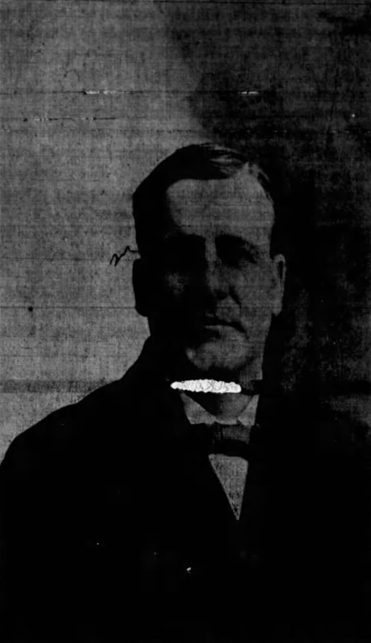
In 1905, the Southern School of Osteopathy officially became the Southern College of Osteopathy. Mr. W. J. Gooch was made business manager of the college with chairpersons Dr. George H. Widener, Dr. Ben Adsit, and Dr. Marie Neely Adsit being named. Dr. Widener was connected with the school for years and “is known to the profession throughout the country as one of the ablest and most painstaking instructors in osteopathic ranks.” Dr. Widener was versed in all branches of the osteopathy and was liked by both teachers and pupils alike. Dr. Benjamin Adsit had been a member of the former faculty along with many years of clinical practice. Dr. Ben Adsit had a, “bright, receptive mind, and a knowledge of the science of osteopathy that few possess, peculiarly fit and adapt him for the position he has been chosen to fill.” Dr. Marie Neely Adsit, the wife of Dr. Ben Adsit, enjoyed “the distinction of being an exceptionally skilled operator of the science.” She was a graduate of high honors and ranked second to no practitioner in the field or teacher in the classroom. She has been associated with the school since 1904, marking her short time at the school as an enviable teacher.
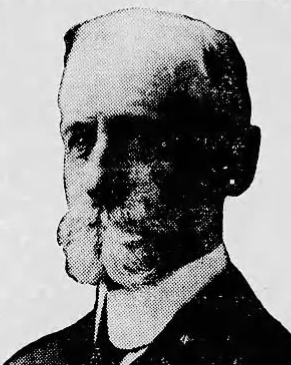

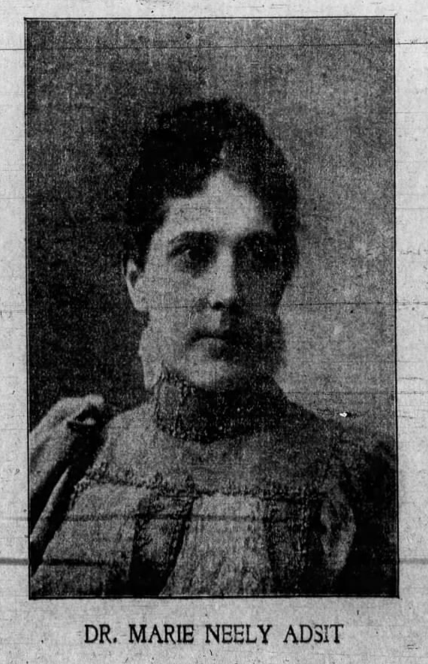
The above images from Leitchfield Gazette, Leitchfield, Kentucky, 8 September 1916 and the Franklin Favorite, Franklin, Kentucky, 10 August 1905
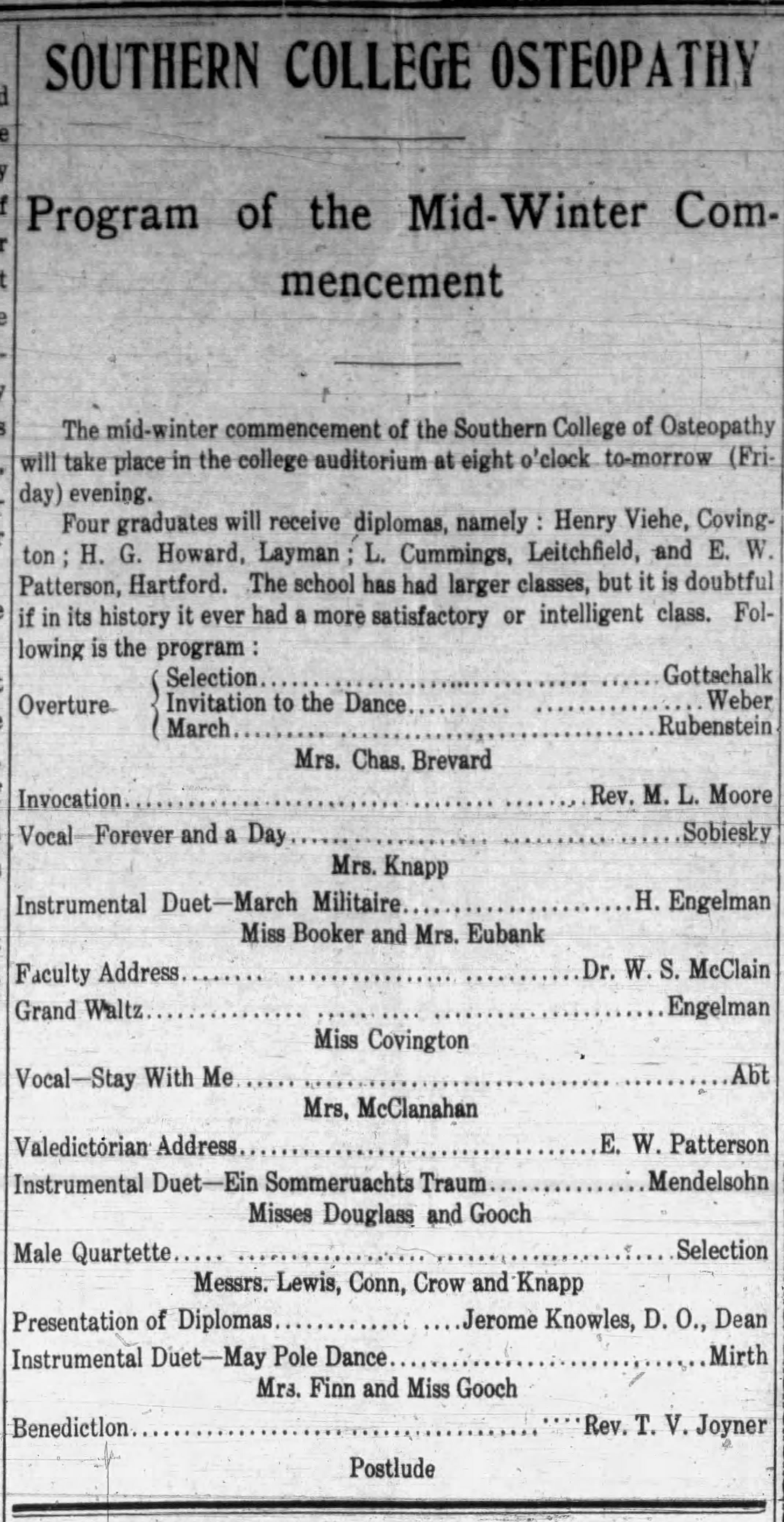
About a decade after its founding, the Southern School of Osteopathy (briefly called the Southern College of Osteopathy), shuttered operations in Franklin and consolidated with the Still College of Osteopathy in Des Moines, Iowa. The Dr. S. S. Still College of Osteopathy then consolidated with the American School of Osteopathy. It appears that the original campus building was sold to the Franklin School System or went back to the local government. In February of 1908, students from the Southern College of Osteopathy had begun matriculating at other locations such as the American School of Osteopathy. In a very brief report in January of 1908, it was noted that the Southern College of Osteopathy would operate until June of that year; at that time, “the doors of the institution will be finally closed and no further effort made to conduct it.” The property was sold to the Board of Trustees of the Franklin Graded School at a price of $10,000. The Board overhauled the existing building and added an annex for a final total cost of about $18,000. It marked the end of a moderately successful osteopathic medical college that struggled without an endowment fund and poor business/accounting management.
Contributed by Shawn Logan | contact@kyhi.org
⁘ Works Cited ⁘
- The Oakland Republican, Oakland, Nebraska, 1 November 1900
- The News-Enterprise, Elizabethtown, Kentucky, 18 January 1901
- The Franklin Favorite, Franklin, Kentucky, 20 January 1908
- The Kirksville Daily Express, Kirksville, Missouri, 13 February 1908
Important note:
If you would like to use any information on this website (including text, bios, photos and any other information) we encourage you to contact us. We do not own all of the materials on this website/blog. Many of these materials are courtesy of other sources and the original copyright holders retain all applicable rights under the law. Please remember that information contained on this site, authored/owned by KHI, is provided under a Creative Commons Attribution-NonCommercial-NoDerivatives 4.0 International License.
Photographs, text, illustrations and all other media not authored by KHI belong to their respective authors/owners/copyright holders and are used here for educational purposes only under Title 17 U.S. Code § 107.

 Kentucky Historic Institutions